
Competency Based Curriculum Implementation
From learning outcomes to teaching, assessment and monitoring. For every educator in the health professions.
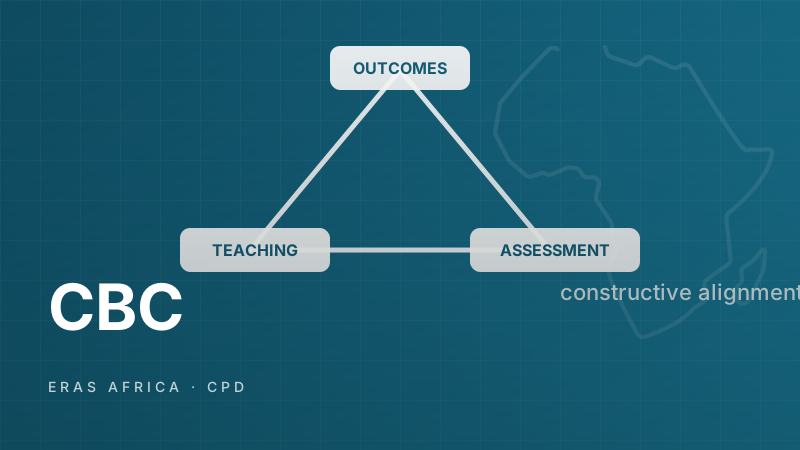
What you will learn
- Define competency and explain why competence is confirmed in practice rather than by a test alone.
- Contrast the competency based curriculum with the traditional curriculum on outcomes, pace, assessment and flexibility.
- Compare behaviourist, cognitive, constructivist, social and experiential learning theories and state one classroom implication of each.
- Describe the VAK learning styles and the characteristics of effective learning.
- Explain the principles of assessment in CBC including validity, reliability, authenticity, feedback, fairness and flexibility.
- Plan a written examination with a blueprint, exam committee review, administration and post exam analysis.
- Define education technology and e-learning and explain their benefits for a competency based curriculum.
- Compare open source and proprietary learning management systems and choose one for a stated context.
- Define monitoring and describe the six steps of curriculum implementation monitoring.
- List the eight areas of information collected when monitoring implementation and the indicators of CBC implementation.
Syllabus
5 modules, each with a knowledge check🎯1. Concepts and principles of CBCA curriculum that asks what graduates can do, not what they were told.4 lessons · 29 min
- 1.1 What competency means7 min
- 1.2 From traditional to competency based7 min
- 1.3 The SPICES model and the curriculum model7 min
- 1.4 Learning hierarchies and constructive alignment8 min
Objectives. Define competency and explain why competence is confirmed in practice rather than by a test alone. Contrast the competency based curriculum with the traditional curriculum on outcomes, pace, assessment and flexibility. State the six principles of CBC and the three cardinal features of the Ethiopian curriculum model. Locate a teaching decision on the SPICES continuum. Apply Bloom and Miller hierarchies and constructive alignment to one module of your programme.
🧑🏫2. Teaching and learning methods in CBCFacilitate, prepare the setting, and teach where the competency lives.4 lessons · 30 min
- 2.1 How adults learn, theories and styles7 min
- 2.2 Planning the learning environment7 min
- 2.3 Problem based learning and the skills lab8 min
- 2.4 Clinical and community based teaching8 min
Objectives. Compare behaviourist, cognitive, constructivist, social and experiential learning theories and state one classroom implication of each. Describe the VAK learning styles and the characteristics of effective learning. Answer the nine planning questions for a session and write a session plan from a module syllabus. Prepare and facilitate a problem based learning tutorial and a skills laboratory demonstration using whole part whole. Prepare, run and close a clinical practice session and a community placement, protecting patient rights.
📝3. Assessment in CBCAssess what the outcome says, at the layer where competence lives.4 lessons · 28 min
- 3.1 Principles of assessment in CBC7 min
- 3.2 Knowledge assessment done properly7 min
- 3.3 The OSCE7 min
- 3.4 Workplace assessment, DOPS and portfolio7 min
Objectives. Explain the principles of assessment in CBC including validity, reliability, authenticity, feedback, fairness and flexibility. Plan a written examination with a blueprint, exam committee review, administration and post exam analysis. Prepare and run an OSCE with a team, blueprint, stations, trained examiners, rubrics and pass criteria. Implement direct observation of procedural skills and portfolio assessment in the workplace. Apply the ETA requirement of at least three knowledge and three performance summative methods per programme.
💻4. Technology supported learningUse the tools you have to reach more students more often, and plan for the power cut.4 lessons · 28 min
- 4.1 What education technology adds6 min
- 4.2 Platforms and blended delivery7 min
- 4.3 Simulation, virtual patients and AI7 min
- 4.4 Making technology stick8 min
Objectives. Define education technology and e-learning and explain their benefits for a competency based curriculum. Compare open source and proprietary learning management systems and choose one for a stated context. Describe simulation technologies, virtual reality, virtual patients and artificial intelligence and their place in health professions education. Analyse the challenges of technology use in Ethiopian higher education and the success factors that overcome them. Plan the institutionalisation of one education technology using the recommended practice points.
📊5. Monitoring, evaluation and making CBC stickKnow whether the curriculum is happening, whether it works, and what to fix.4 lessons · 29 min
- 5.1 Monitoring curriculum implementation7 min
- 5.2 Evaluation models and Kirkpatrick7 min
- 5.3 Challenges, enablers and policy7 min
- 5.4 Your CBC implementation plan, capstone8 min
Objectives. Define monitoring and describe the six steps of curriculum implementation monitoring. List the eight areas of information collected when monitoring implementation and the indicators of CBC implementation. Compare the experimental, CIPP, logic and Kirkpatrick evaluation models and build a Kirkpatrick tool. Explain the common challenges of implementing CBC in resource limited settings and the enabling factors and policy enforcement that overcome them. Write a CBC implementation plan for one module of your own programme.
How it is taught
Narrated micro lessons
Every screen has recorded narration that adds context and examples from Ethiopian hospitals. Lessons are five to ten minutes and resume where you stopped, on any device.
Decisions, not slides
Branching scenarios, matching, ordering and short written tasks with immediate feedback and the reasoning, whichever way you answer.
Blended option
Five ninety minute workshops, one per module, using the same cases for local adaptation.
Tools for Monday
Printable ward cards, checklists and audit forms are linked from the modules and free to adapt.
Frequently asked
How long do I have?
There is no deadline. Most learners finish in one to three weeks of short sessions. Your progress is saved to your account.
Is there a cost?
No. Enrolment, the course, the certificate and the resources are free.
What if I fail the post-test?
You can retake it. The feedback after each item tells you which module to revisit.
Is the certificate recognised for licence renewal?
The certificate states the CEU value calculated at one CEU per hour of learning in line with the national CPD Guideline, with a verification number. Recognition for licence renewal depends on accreditation by the CPD accreditor, which ERAS Africa and the EAA are pursuing.
Can my hospital run it as a workshop?
Yes. Each module has a facilitated 90 minute session plan. Contact ERAS Africa through the website to arrange a cohort.